Ski tips
Learn how skiing lessons progress from snowplough to parallel turns, carving and off-piste. Understand each stage of your development and how an instructor guides you through.
If you've never skied before, the sport can seem intimidating. You've probably watched people carving down mountains at speed and wondered how anyone gets from standing nervously at the bottom of a beginner slope to that level of control and confidence.
The truth is, skiing follows a clear progression. Every skier in the world, from weekend enthusiasts to Olympic champions, has moved through the same fundamental stages. Understanding this progression helps you understand your level, know what to expect from your lessons, set realistic goals, and appreciate each milestone along the way.
Please note: Children often follow a different progression to adults, this means a kid's ski lesson can look very different to an adult ski lesson.
Before you even put your skis on, the first thing your instructor will do is to introduce you to your equipment. How to put your boots on, which end of the skis go down the hill (generally the pointy end), etc.
Before starting your lesson, it is often a good idea to run through all the ski gear and equipment you will need for your first lesson. This will save you a last minute trip to the ski hire shop.
Your first hour on skis won't involve any turning at all. Before you can steer, you need to feel comfortable simply standing on snow with two planks attached to your feet, sliding down the hill and bringing yourself to a stop.
The snowplough position, sometimes called the wedge or pizza, is the foundation of everything that follows. Your skis form a V-shape with the tips close together and the tails apart. This position creates natural resistance against the snow, giving you control over your speed without needing to do anything complicated.
Your instructor will start you on a gentle, flat slope. The goal is simple: point your skis downhill, let gravity pull you forward, and use the snowplough to control how fast you go. Widen the wedge to slow down, narrow it to speed up. That's it.
This stage is about building confidence. You're learning to trust your equipment, understand how your weight affects your movement, and develop the muscle memory that will underpin everything else. Most people can achieve a comfortable snowplough straight run within their first lesson.
What your instructor is watching for: your balance point, how relaxed your upper body is, whether you're looking ahead rather than down at your skis, and how instinctively you're adjusting the width of your wedge.
Once you can control your speed in a straight line, the next step is steering. The snowplough turn introduces the fundamental principle that governs all skiing: if you put more weight on one ski and simultaneously rotate your legs, you'll turn in that direction.
Still in your wedge position, you'll learn to shift your weight onto your right ski and rotate it to turn left, and onto your left ski and rotate it to turn right. Your instructor will likely use the image of pressing down and rotating through one foot, as if you're twisting off a bottle cap with the ball of your foot. The weighted ski grips the snow and carves a gentle arc, bringing you around.
At this stage, you're linking turns together, creating an S-shaped path down the slope. Each turn bleeds off speed, so you're always in control. The sensation is surprisingly intuitive once it clicks, and most people experience a genuine breakthrough moment when steering suddenly makes sense.
This is typically where lessons become genuinely enjoyable. You're no longer just surviving; you're actually skiing. You can navigate around other people, choose your own line down the slope, and start to feel the rhythm that makes skiing so addictive.
What your instructor is watching for: smooth progressive weight transfer rather than abrupt movements, maintaining the wedge shape throughout the turn, looking in the direction you want to go, and gradually building confidence to attempt slightly steeper terrain.
Between snowplough turns and full parallel skiing lies an important transitional phase that most skiers pass through naturally. In ski instruction terminology, this is called the wedge parallel, sometimes referred to as the christie.
The movement pattern is straightforward: you begin each turn in a small wedge, just as you learned in snowplough turns, but as the turn develops, you gradually steer your inside ski to match the outside ski, finishing the turn with both skis parallel. The wedge initiates the turn and provides stability during the vulnerable moment of changing direction; the parallel finish allows for a cleaner, more efficient completion.
What makes this stage feel different is the active role of the inside leg. Rather than maintaining a static wedge throughout the turn, you're now steering that inside ski more deliberately, tipping it from its inside edge onto its outside edge and rotating it to align with the direction of travel. The forces generated by the turn and the weighting of the outside ski actually assist this matching movement, which is why many skiers find it happens almost spontaneously once they build enough speed and confidence.
The point at which your skis come parallel will vary. Early in this phase, the match might happen only in the final moments of the turn. As your skills develop, you'll find the skis coming together earlier and earlier in the arc, until the wedge becomes barely perceptible. This is the natural bridge to true parallel skiing.
Your instructor will use exercises that encourage earlier matching: traversing with skis parallel, then initiating a turn with a small wedge and focusing on bringing the inside ski alongside as soon as possible. The emphasis is on active steering of both legs rather than relying on the wedge for control.
What your instructor is watching for: the timing of when skis become parallel, whether matching comes from steering the whole inside ski or just pulling the tail across, balance transferring progressively to the outside ski, and confidence increasing to attempt the match earlier in each turn.
Once the wedge has shrunk to nothing, you've arrived at parallel skiing. Both skis now stay together throughout the entire turn, from initiation to completion, moving as a coordinated unit. The skills you developed during wedge parallel, particularly that active steering of the inside leg and the progressive transfer of balance to the outside ski, now happen simultaneously rather than sequentially.
The key difference is in how you start each turn. Instead of opening into a wedge to initiate direction change, you release both edges together and steer both skis into the new turn at the same time. This requires a moment of commitment, allowing your body to move across your skis and into the new turn before the edges fully engage. It's the moment that felt risky during wedge parallel but now becomes fluid and natural.
Parallel skiing opens up the mountain. You can link turns rhythmically, control your speed through turn shape rather than braking, and tackle steeper terrain with confidence. Your upper body stays relatively quiet and faces down the slope while your legs do the steering work beneath you.
Your instructor will focus on refining the movements you've already learned. The pole plant, introduced during this phase, helps with timing and provides a reference point for initiating each turn. Your weight stays forward over the balls of your feet. Your ankles and knees flex and extend rhythmically, managing pressure through each arc.
This stage rewards patience. The shape of parallel turns might come relatively quickly, but making them feel automatic across varying terrain and conditions takes time. Most skiers spend multiple weeks or seasons building this consistency, gradually increasing speed and venturing onto more challenging runs as confidence grows.
What your instructor is watching for: simultaneous steering of both skis from turn initiation, consistent stance width throughout the turn, effective pole plant timing, upper body discipline, and the ability to maintain technique as speed and terrain difficulty increase.
Once you've developed confident parallel turns, the mountain truly opens up. This is where many skiers begin exploring specific areas of the sport, each requiring its own technical refinements.
Carving represents the purest form of skiing on groomed runs. Instead of steering your skis through turns using muscular effort, you tip them onto their edges and let the sidecut, the curved shape built into every modern ski, do the work. The ski bends into an arc and follows that arc precisely, leaving two clean tracks in the snow.
Carved turns are fast and efficient. There's no skidding, no scraping, just smooth arcs at speed. Learning to carve requires excellent balance, strong edge awareness, and the confidence to commit to high angles. Your instructor will work on exercises that isolate edging movements, helping you feel the difference between a steered turn and a carved one.
Mogul fields, those intimidating fields of bumps that form on steeper runs, require a completely different approach. The technique centres on absorbing terrain with your legs while keeping your upper body stable, almost like your lower body is a suspension system operating independently.
Your instructor will teach you to navigate moguls by skiing the troughs, the valleys between bumps, rather than going over the tops. The rhythm is quick and demanding. Legs compress and extend continuously, knees drive forward, and pole plants become essential for timing. Many skiers avoid moguls entirely, but with proper instruction, they become another enjoyable dimension of the sport.
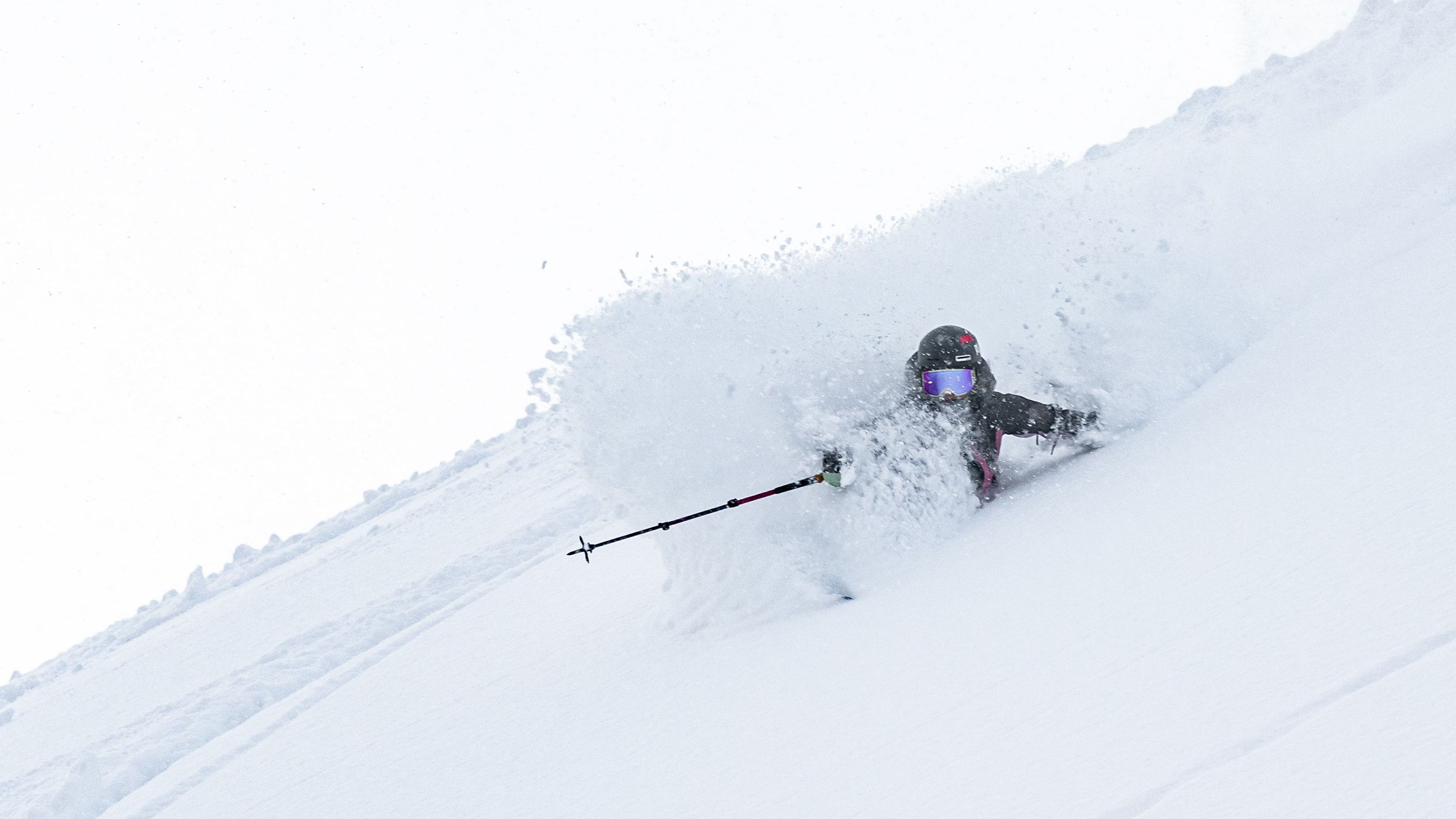
Skiing off-piste means leaving the groomed runs for untracked snow. This might be fresh powder after a storm or the variable conditions found in the terrain between marked runs.
Off-piste skiing requires significant adaptation. In deep snow, you need to weight both skis more equally than on-piste. The turn initiation changes, you unweight by extending your legs rather than by pushing down. Speed becomes your friend because it keeps you floating on the surface rather than sinking.
Beyond technique, off-piste skiing demands avalanche awareness, terrain reading skills, and knowledge of mountain safety protocols. A good instructor will introduce these elements gradually, building both your technical ability and your mountain sense simultaneously.
Freestyle encompasses jumps, tricks, terrain parks, and anything involving getting airborne. It's become hugely popular, particularly with younger skiers, and has its own progression of skills.
Beginning freestyle work might start with small jumps and basic grabs. Your instructor will teach you how to approach a jump, how to take off in balance, how to spot your landing, and how to absorb impact safely. Terrain parks offer features of increasing size and difficulty, allowing you to progress at your own pace.
Freestyle requires confidence and commitment, but the fundamentals, balance, edge control, air awareness, build naturally from the parallel skiing foundation.
Throughout every stage of this progression, your instructor serves several crucial functions.
Assessment and adaptation. A good instructor constantly evaluates your movement patterns, identifies what's working and what isn't, and adjusts their teaching approach accordingly. Two students at the same nominal level might need completely different cues, images, or exercises to achieve the same outcome.
Terrain selection. Choosing the right slope for each exercise is an art. Too steep and you'll be fighting survival instincts rather than learning new movements. Too flat and you won't have the speed needed for certain techniques to work. Your instructor knows the mountain and selects terrain that sets you up for success.
Safety and mountain awareness. Beyond technique, your instructor teaches you how to behave on the mountain: where to stop, how to merge with traffic, how to assess conditions, when to call it a day. These practical skills are just as important as technical ones.
Motivation and pacing. Progress in skiing isn't linear. Some days everything clicks; other days movements that felt natural suddenly feel awkward. An experienced instructor knows when to push you toward the next challenge and when to consolidate what you've already learned.
Feedback and correction. You can't see yourself ski. Your instructor provides the external perspective you need, catching habits before they become ingrained and helping you feel the difference between incorrect and correct movements.
A Ski instructor will make a real difference to how fast you learn and your enjoyment. However, ski instruction is deeply personal. Different instructors have different specialities, communication styles, and approaches to learning. Some excel with nervous beginners; others shine with advanced skiers seeking refinement. Some favour technical explanations; others work primarily through feel and imagery.
This is why the traditional model, where you book a lesson and get assigned whoever is available, can be hit or miss. The instructor you're paired with might be technically excellent but simply not the right fit for how you learn.
The alternative is choosing your instructor based on their profile, experience, teaching style, and the specific feedback of previous students. When you know you'll be working with someone whose approach matches what you need, lessons become more productive and more enjoyable.
If you're booking ski lessons for the first time, here's a realistic picture of the typical progression:
Day one: Getting comfortable on flat terrain, basic movement and balance exercises, snowplough straight runs on a very gentle slope. By the end of the day, you should be able to stop reliably.
Day two: Snowplough turns, linking multiple turns together, starting to navigate real beginner terrain with confidence.
Days three to five: Refining snowplough turns, beginning the transition toward parallel skiing, venturing onto slightly steeper or longer runs.
Week two and beyond: Developing parallel turns, building confidence across varied terrain, starting to think about speed and flow rather than just survival.
Everyone progresses differently. Fitness, age, previous board sport experience, and simple aptitude all play a role. The timeline above is typical, but don't be discouraged if you need more time, and don't be surprised if you progress faster.
Skiing is one of those rare sports where the learning never stops. Even professional skiers continue working with coaches, refining their technique, and discovering new aspects of the sport.
That first moment when you link a few snowplough turns might not feel like much compared to someone carving at speed down a black run. But the sensation, the gliding movement, the control, the way the mountain opens up before you, is the same. You're skiing. And with each lesson, each run, each small refinement, the sport reveals more of itself.
Understanding the progression from snowplough to carving to the specialist disciplines isn't about rushing through stages to get to the "good stuff." Each stage has its own pleasures and its own lessons. The journey is the point.
Find an instructor who understands that, who meets you where you are, and who can guide you toward where you want to be. That's what transforms skiing from something you do into something you love.